

Manufacturing KPIs vs OEE Metrics
What are the optimal manufacturing metrics to capture to get team buy-in and drive rapid improvements?

In today's competitive manufacturing landscape, measuring performance effectively is crucial for driving profitability, maximizing manufacturing capacity, and driving continuous improvement.
While many manufacturers rely solely on traditional Key Performance Indicators (KPIs), implementing a comprehensive Overall Equipment Effectiveness (OEE) platform can transform how you measure and improve operational excellence. Though KPIs remain valuable, OEE's systematic approach to measuring availability, performance, and quality provides deeper insights into your manufacturing operations.
Manufacturing KPIs
Traditional manufacturing KPIs have long served as the basic building blocks for measuring operational performance, but they often fall short of delivering the real-time, interconnected insights modern manufacturing demands.
- Production Attainment — actual output against planned targets; best-in-class manufacturers typically achieve 95% or higher.
- Manufacturing Cost Per Unit — all production-related costs divided by total units produced; industry leaders aim to stay within 85% of theoretical cost models.
- Maintenance Cost Per Unit — leading manufacturers typically spend 2 to 4% of asset replacement value annually on maintenance.
- Production Downtime — world-class operations keep unplanned downtime below 2% of scheduled production time.
- Capacity Utilization — top performers operate at 85 to 90% capacity utilization.
- Overtime Rate — best-practice manufacturers keep overtime below 5% of total labor hours.
Manufacturing OEE
OEE combines three critical components into one simple objective measurement of your production efficiency: availability (machine uptime versus scheduled production time), performance (actual production rate versus theoretical maximum), and quality (good units produced versus total units started).
The final OEE score is calculated by multiplying these components together: OEE = Availability × Performance × Quality. For example, an availability score of 90%, performance of 95%, and quality of 98% gives an OEE of 83.7%.
Benefits of OEE Metrics over KPIs
- Holistic Performance View — a single, objective metric that production teams own and understand, rather than a complex dashboard of disconnected numbers.
- Production Team Ownership — unlike KPIs tracked by management or separate departments, OEE is fully owned by the production team, which creates accountability and engagement.
- Real-Time Decision Making — modern OEE systems provide immediate feedback, letting operators and managers make quick adjustments.
- Cross-Plant Comparison — OEE's standardized calculation method enables meaningful comparisons across lines, plants, or even industries.
- Financial Impact Visibility — modern OEE platforms translate performance issues into direct dollar impact, so team members see exactly how much money specific inefficiencies are costing, instead of abstract minutes of downtime.
While traditional KPIs have their place, implementing a comprehensive OEE platform provides the most powerful approach to performance measurement, offering detailed insight into specific aspects of operations alongside a complete view of production efficiency through one actionable metric.
To implement effective performance measurement: start with clear baseline measurements, set realistic improvement targets, ensure data accuracy and consistency, provide regular feedback to operators and management, and use insights to drive specific improvement initiatives.
Remember, the goal isn't just to measure performance but to use these insights to drive meaningful improvements in productivity, quality, and cost efficiency.
Ready to transform your plant floor?
See how Essembi drives real results for your manufacturing team with a personalized demo.
More from the blog
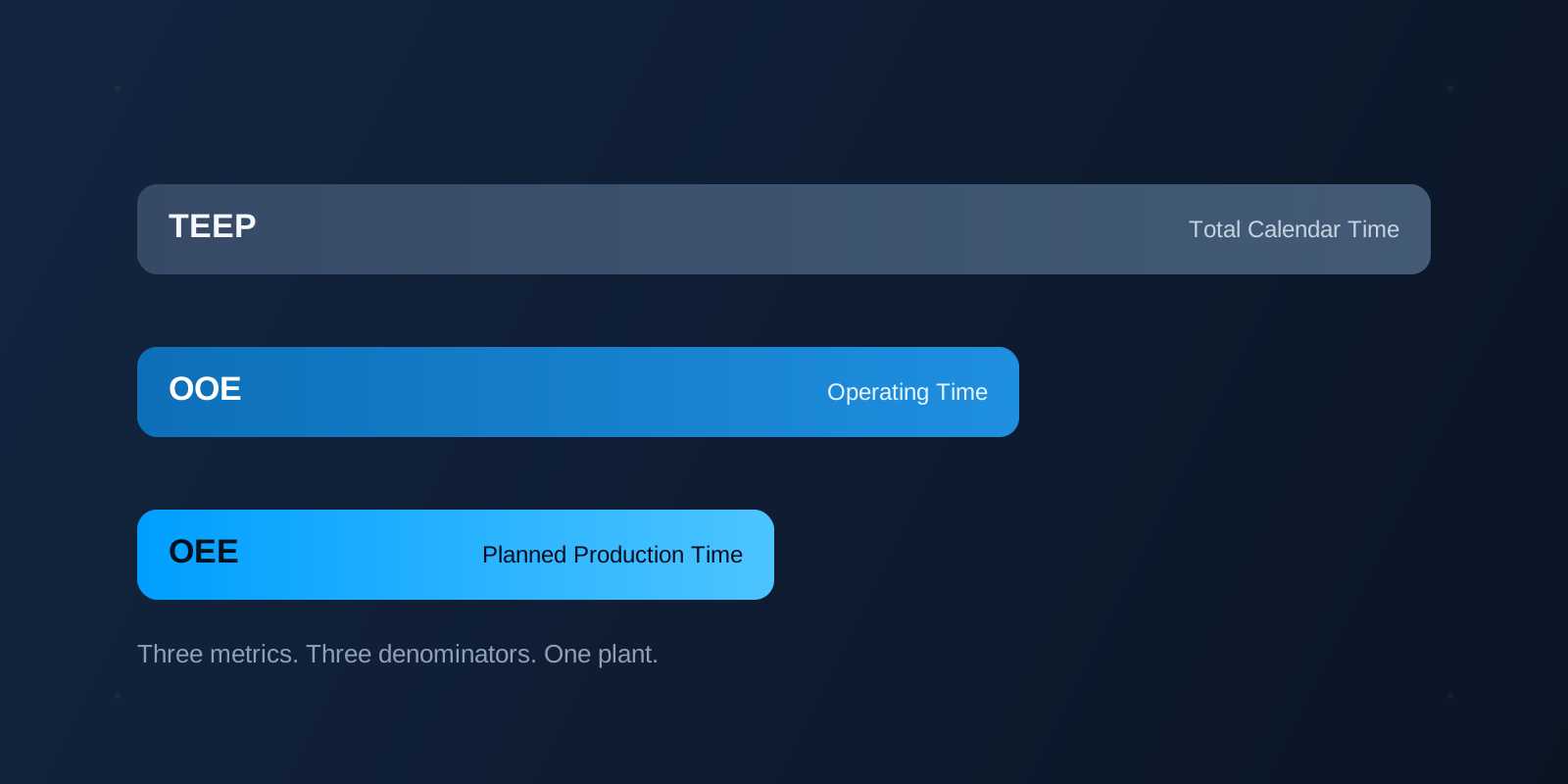
OEE vs. OOE vs. TEEP: Why One Metric Was Never Going to Be Enough
OEE tells you how well you ran the time you scheduled. OOE and TEEP reveal how much capacity you never scheduled in the first place. Here's how the three metrics fit together, who should own each one, and how to turn all three into action.
Read more
Ask Your Plant Floor Data a Question with AI
Essembi's new AI chat lets manufacturing leaders ask questions about downtime, maintenance, and quality, then dig deeper with follow-ups.
Read more
Know Exactly What Every Job Costs With RFID Labor Tracking
Track labor costs from changeover to the last unit off the line with RFID badge scanning built into Essembi.
Read more